

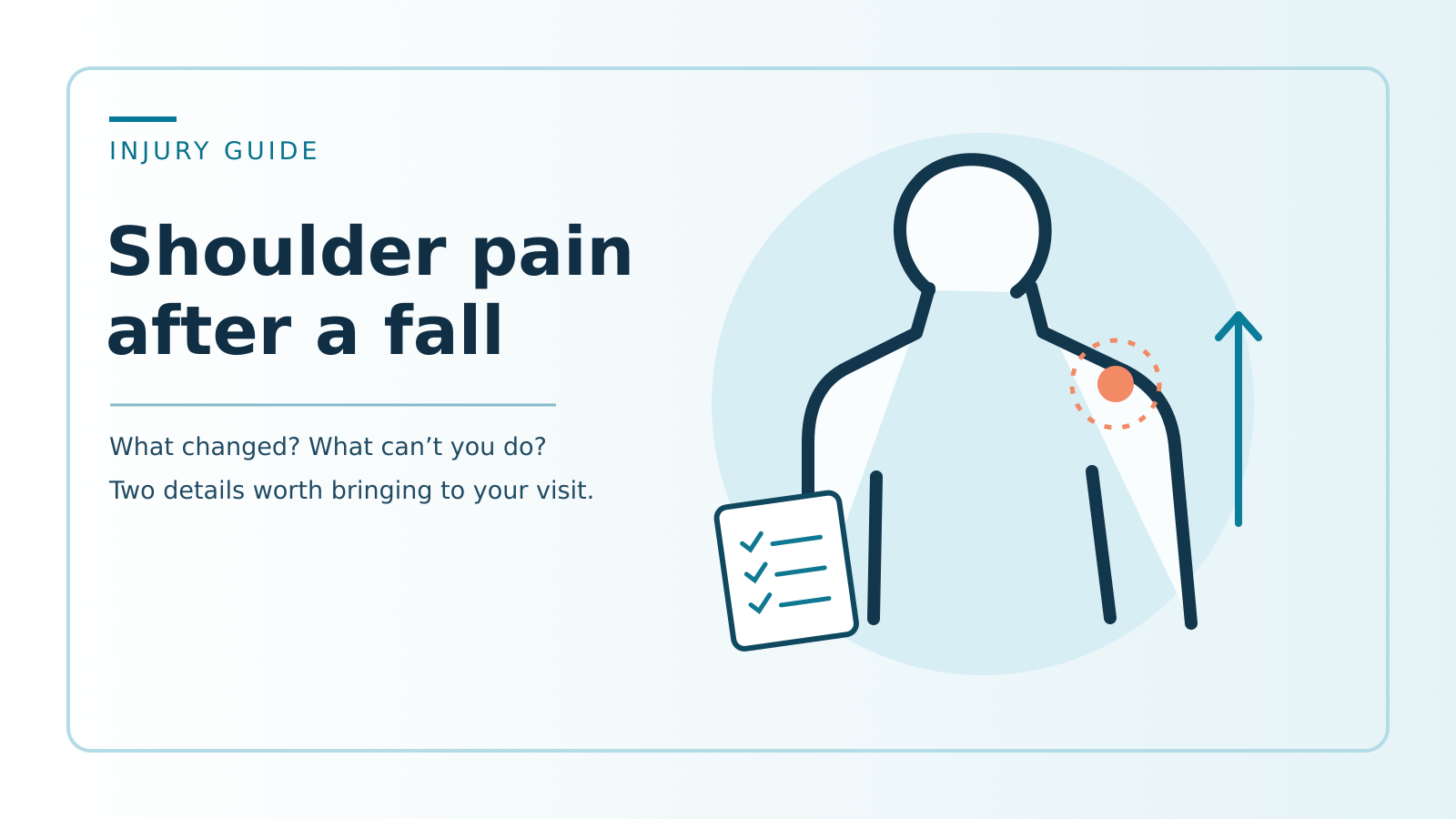
You catch yourself on the way down, stand up, and notice that reaching for your phone is suddenly difficult. How your shoulder landed, and what you could do immediately afterward, are useful details to share. A significant new loss of motion or strength after a fall is a reason for prompt medical assessment, not a reason to keep testing the arm.
When to get help
Seek urgent medical assessment for shoulder pain after a fall, particularly if you cannot lift the arm, pain is severe, the shoulder looks out of shape, or swelling is substantial. If there is an obvious deformity, persistent numbness, or the hand becomes cold or discolored, go to an emergency department. Call 911 for a serious injury if you cannot get there safely. Do not try to pop a shoulder back into place.
Tell the clinician what happened, not just where it hurts
How you landed. Did you land on the shoulder, put out a hand, or grab a rail as you fell?
What changed right away. Was it suddenly hard to lift the arm, or did the difficulty build later? Was there a pop?
What you still cannot do. Mention practical changes such as dressing, reaching a shelf or steering, and note any numbness, swelling or bruising.
A fracture, dislocation and tendon injury can all make movement difficult. These questions help guide an exam; they are not a home test. An X-ray can help assess the bones and joint position. If weakness or inability to lift persists after an initial visit, ask the treating clinician what follow-up is needed. A normal X-ray does not show every tendon injury.
Where rehabilitation fits
Once the injury has been assessed and the treating clinician says rehabilitation is appropriate, ask which movements are safe now, which to hold off on, and how progress will be measured. Being able to put on a shirt or reach a kitchen shelf may be more useful to track than simply counting the days since the fall.
Common questions
Should I keep trying to lift the arm to see if it improves?
Do not force painful movement or test the arm with weights after a fall. Get the injury assessed and follow the clinician’s movement instructions.
Is a painful shoulder after a fall always a rotator cuff tear?
No. A fall can injure several structures. The history, physical examination and, when needed, imaging help determine the cause.
Start with the right level of care
For urgent symptoms, seek medical care first. For non-emergency questions about physical therapy after evaluation, call Orlando City Health & Wellness in Orlando at (407) 250-5566 or Winter Park at (407) 960-6702.
Sources: NHS: Shoulder pain; AAOS OrthoInfo: Rotator cuff tears. This article is educational and is not a diagnosis or treatment plan.