

Before Back Surgery, See If You Have Another Option.
A herniated disc, bulging disc or sciatica does not automatically mean your next stop has to be surgery. Orlando City Health & Wellness offers an integrated, non-surgical spinal decompression program designed for selected cervical and lumbar disc patients who want to exhaust conservative options first.
Disc Pain Can Be Severe. Your First Step Does Not Have to Be an Operating Room.
For patients without emergency neurological findings or another clear surgical indication, conservative care is commonly considered before surgery. Our goal is simple: determine whether your neck or low-back condition may respond to a coordinated, non-surgical program using decompression, chiropractic care and physical rehabilitation.
No Incisions
Mechanical spinal decompression is non-invasive. There are no surgical incisions, hardware placement or wound-healing period from the decompression treatment itself.
No General Anesthesia
Decompression sessions do not require general anesthesia. Patients are awake, monitored and treatment forces are adjusted to comfort and clinical response.
Less Treatment Downtime
Unlike an operation, decompression itself generally does not require a post-surgical recovery period. Activity recommendations depend on your symptoms and diagnosis.
What a Disc Injury Can Do to a Nerve
When disc material bulges or herniates toward a nerve root, symptoms may travel far beyond the spine. A lumbar disc problem may create buttock or leg pain commonly called sciatica, while a cervical disc problem may contribute to neck, shoulder, arm, hand, numbness or tingling symptoms.

Lumbar Disc Herniation & Sciatica
This illustration shows the progression from a normal disc to degenerative, bulging and herniated disc changes. When a lumbar disc irritates a nerve root, symptoms can travel into the buttock and leg as sciatica, burning, tingling, numbness or radiating pain.
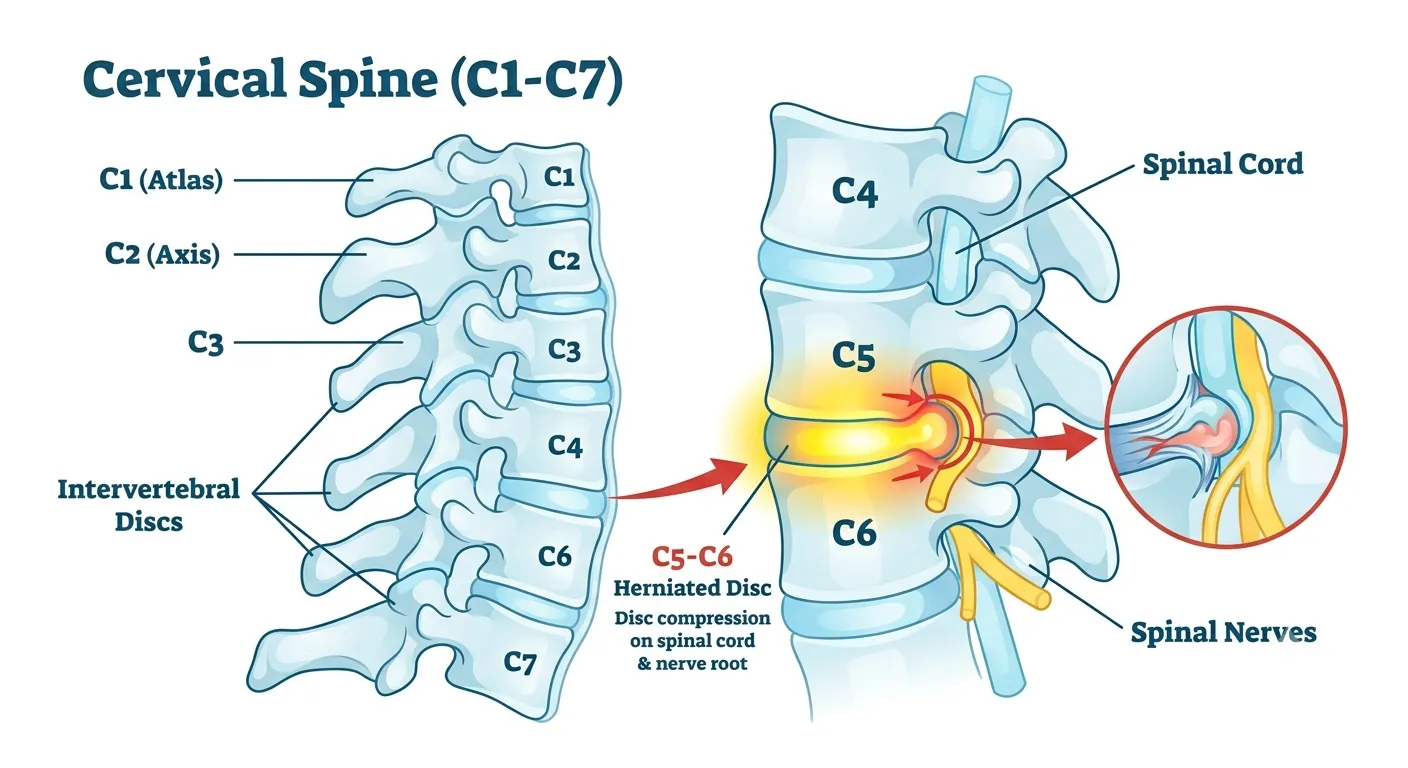
Cervical Disc Herniation
Cervical disc problems can contribute to neck pain and symptoms extending toward the shoulder, arm or hand depending on which structures are involved.
Purpose-Built Equipment for Cervical & Lumbar Decompression
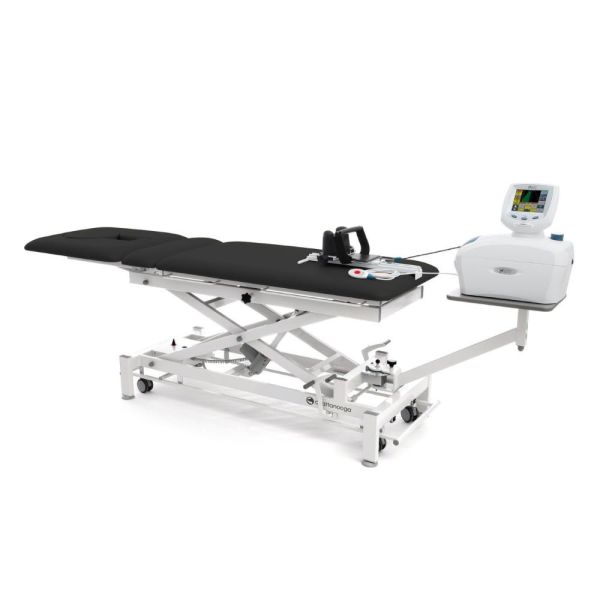
Our decompression program uses professional traction equipment designed specifically for controlled cervical and lumbar spinal traction—not a generic stretching table. The system allows our team to precisely control positioning, treatment force, hold and rest cycles, and treatment time.
- Roller-mounted surface reduces friction beneath the hips and legs
- Designed for both prone and supine traction positioning
- Adjustable head/back section for precise patient positioning
- Electric height adjustment for clinician control and patient access
- Professional traction unit allows controlled, repeatable treatment forces
- Static, intermittent and cyclic traction options depending on clinical need
- Pull, hold, rest and treatment time can be individualized
- Built-in patient safety interruption features on the traction system
Built Around Unloading the Spine—Then Rebuilding Function.
Traction therapy uses controlled pulling forces to reduce mechanical loading on spinal structures. The treatment can be programmed to gradually introduce and reduce force, which may improve comfort and limit guarding in selected patients.
Disc & Nerve Unloading
Traction is intended to temporarily reduce mechanical pressure affecting discs and nerve roots while the patient is positioned on a low-friction traction surface.
Custom Treatment Forces
Treatment is not one-size-fits-all. Force, angle, treatment duration, hold/rest cycles and progression are selected according to the spinal region, body size, diagnosis, symptoms and tolerance.
Pair It With Rehabilitation
Reducing symptoms is only part of the goal. Strength, mobility, stabilization and movement capacity are addressed through rehabilitation when indicated.
Choose Focused Decompression—or Our Full Disc Recovery Program.
Both pathways begin with an evaluation. The right program depends on your symptoms, imaging, examination findings, goals and whether additional rehabilitation is appropriate.
Focused Spinal Decompression
For patients seeking targeted cervical or lumbar decompression as the central component of care.
- Free initial decompression consultation
- Cervical or lumbar treatment pathway
- Customized traction settings
- Progressive treatment plan
- Clinical reassessment
- Home recommendations
Disc Recovery & Rehabilitation
Our most comprehensive option combines decompression with the other services available within Orlando City Health & Wellness when clinically appropriate.
- Spinal decompression therapy
- Chiropractic care
- One-on-one physical therapy
- Core stabilization and strengthening
- Mobility and movement retraining
- Shockwave therapy when appropriate
- Medical wellness / peptide consultation when appropriate
- Progress monitoring and return-to-activity plan
We Don't Just Pull on the Spine and Send You Home.
Disc cases can involve pain, nerve irritation, muscle guarding, weakness, poor spinal mechanics, limited mobility and deconditioning. Our advantage is being able to address multiple pieces of the problem within one coordinated clinic.
Decompression + Chiropractic
Chiropractic treatment may help address joint restriction and spinal mechanics while decompression focuses on controlled unloading. Treatment is modified around the patient's diagnosis and tolerance.
Decompression + Physical Therapy
Our physical therapy team can build strength, improve mobility and reinforce movement patterns so treatment is not limited to passive symptom relief alone.
Imaging & Clinical Evaluation
When clinically indicated, imaging and examination findings help determine whether symptoms are consistent with disc involvement and whether decompression is appropriate.
Peptide & Medical Wellness Consultation
Patients interested in additional wellness options may separately discuss peptide-based therapies with an appropriate medical provider. These options are not substitutes for decompression and have their own evidence and regulatory considerations.
“Have I Exhausted the Appropriate Conservative Options?”
Surgery can be necessary and sometimes urgent. But in the absence of serious neurological deficits or another surgical indication, conservative treatment is commonly considered first for lumbar disc herniation. That is exactly where our integrated decompression and rehabilitation program fits.
| Consideration | Non-Surgical Decompression Program | Spine Surgery |
|---|---|---|
| Incisions | None from decompression | Varies by surgical procedure |
| General anesthesia | Not required for decompression | Often required depending on procedure |
| Implants / hardware | None from decompression | May be required for some procedures |
| Immediate post-procedure downtime | No surgical recovery period from decompression itself | Recovery varies significantly by procedure and patient |
| Rehabilitation | Can be integrated from the start | May be needed after surgery |
| Best role | Selected patients appropriate for conservative care | Important when surgery is medically indicated or conservative care fails |
A 2024 WFNS Spine Committee review noted that only a small percentage of patients with lumbar disc herniation are surgical candidates and recommended conservative treatment first in the absence of cauda equina syndrome, motor deficits or other serious neurological findings.
Conservative Care Can Be a Meaningful First Step.
2025 Systematic Review
A 2025 systematic review and meta-analysis of conservative physiotherapy for lumbar disc herniation reported improvements across traction, exercise and manipulation groups. Traction had the largest pooled effect size, although study heterogeneity was high and the authors emphasized the need for better standardized research.
Find Out If You Can Start With a Non-Surgical Plan.
If you have been told you have a herniated disc, bulging disc, sciatica or a disc-related neck or low-back problem, call us. Bring your MRI or imaging if you have it. We will discuss whether spinal decompression and rehabilitation may be reasonable options for your case.
Ask about our two cervical and lumbar spinal decompression programs.
Spinal Decompression FAQ
Is spinal decompression an alternative to back surgery?
For selected patients, spinal decompression can be part of a conservative treatment plan attempted before surgery. It is not a replacement for medically necessary surgery and should not delay urgent surgical evaluation when serious neurological findings are present.
Can it help a herniated or bulging disc?
Traction may improve pain and function for some patients with disc-related symptoms and is often combined with rehabilitation to improve movement, strength and activity tolerance.
Can decompression help sciatica?
When sciatica is related to lumbar disc or nerve-root irritation, decompression may be considered after an appropriate evaluation. Sciatica has multiple possible causes, so determining the source of symptoms matters.
What machine do you use?
We use professional Chattanooga traction technology with the Galaxy TTET300 three-section traction table. The table uses roller-mounted sections to minimize friction so controlled traction forces can be delivered more efficiently.
How much downtime is there after treatment?
Spinal decompression itself does not involve an incision, general anesthesia or a surgical wound. There is therefore no surgical recovery period from the decompression treatment itself, although activity recommendations depend on your condition and symptoms.
Can you combine decompression with chiropractic and physical therapy?
Yes, when appropriate. One of the primary advantages of our program is the ability to coordinate decompression, chiropractic care and one-on-one physical therapy within the same practice.
How do I get started?
Call Orlando City Health & Wellness at (407) 504-0117 and schedule a free spinal decompression consultation. If you have an MRI or other imaging, bring it with you.